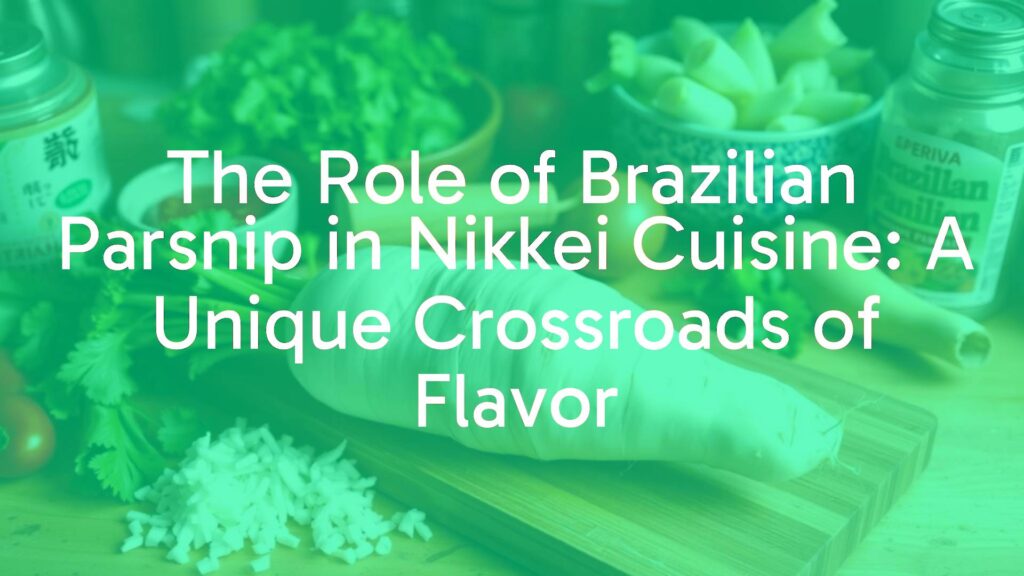
Brazilian Parsnip – A Distinctive Player in Nikkei Cuisine
Nikkei cuisine, celebrated for its inventive union of Japanese and Peruvian gastronomy, has gradually embraced a variety of international ingredients. One such notable inclusion is the Brazilian parsnip, a root vegetable that brings novelty and depth to the evolving kitchen of Nikkei chefs. This article explores how the Brazilian parsnip is utilized in Nikkei dishes, delving into its sensory attributes, historical convergence, and its function as a culinary bridge between two rich traditions.
Characteristics: Taste, Texture, and Visual Appeal
Brazilian parsnip, known for its creamy white hue and elongated form, distinguishes itself with a flavor profile that is both sweet and earthy, often punctuated by subtle nuttiness. When cooked, its texture develops into a pleasant tenderness, maintaining enough firmness to add body to dishes. Aromatically mild, the ingredient does not overshadow other elements, making it particularly compatible with both the umami depth of Japanese fare and the vibrant, acidic notes common in Peruvian food.
Historical Context and Introduction to Nikkei
The inclusion of Brazilian parsnip in Nikkei cuisine reflects the genre’s openness to experimentation and adaptation. While parsnips are not indigenous to either Japan or Peru, the agricultural connections fostered between Brazil and Peru—and, by extension, the larger South American continent—made their introduction possible. Contemporary Nikkei chefs, inspired by cross-border culinary innovations, have reimagined the parsnip beyond its traditional roles, viewing it as a canvas for the intersection of flavor cultures.
Bridging Japanese Precision and Peruvian Soul
In the Nikkei kitchen, the Brazilian parsnip often serves as a meeting point for Japanese and Peruvian techniques. Its versatility allows it to be prepared in delicate julienne for crisp salads reminiscent of sunomono, or roasted and pureed to form a base for ceviche accompaniments. Its inherent sweetness provides balance to Peruvian chili pastes, while its sturdy texture can emulate classic Japanese root vegetables like daikon, inviting chefs to apply familiar cutting or simmering methods. By harnessing both subtlety and earthiness, Brazilian parsnip elegantly intertwines two distinct yet complementary culinary philosophies.
Defining the Fusion Experience in Nikkei Cuisine
Brazilian parsnip’s essential role in Nikkei cuisine lies in its capacity to unify and expand established flavors without dominating them. It enriches fusion dishes such as tiraditos with creamy parsnip purees or tempura, where its natural sweetness is accentuated by light Japanese batters and dipping sauces. The ingredient’s adaptability complements the Nikkei ethos: celebrate the harmony possible when divergent traditions meet on a shared plate. Its presence stands as an emblem of how Nikkei cuisine continues to redefine itself, drawing on new influences to craft tastes and textures unlike any found in its parent cultures alone.
Conclusion
The Brazilian parsnip exemplifies the inventive spirit of Nikkei cuisine. Through its subtle flavor, appealing texture, and historical serendipity, it showcases how a single ingredient can help redefine the boundaries of cross-cultural cooking. As chefs continue to innovate, expect the Brazilian parsnip to remain a symbol of Nikkei’s dynamic fusion and culinary openness.
